Lab Ultrasonic Coating for Energy Materials
Application of Ultrasonic Spray Coating Machines in Energy Materials Laboratory Research
In the process of innovation and development in the energy field, laboratory research on energy materials is a key link in driving technological breakthroughs. Whether it’s the development of new battery materials, photovoltaic thin-film materials, or energy storage electrode materials, precise and efficient material preparation and processing equipment is needed to meet the stringent requirements of experiments regarding coating uniformity, thickness control, and sample stability. Ultrasonic spray coating machines, with their unique technical characteristics, have become an important auxiliary device for laboratory research on energy materials.
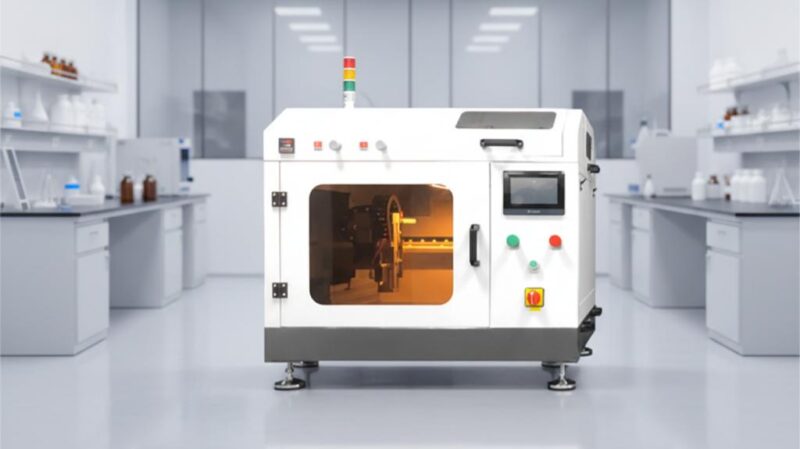
From a technical perspective, ultrasonic spray coating machines atomize solutions or suspensions of energy materials into tiny, uniformly sized droplets through high-frequency vibration. These droplets are then precisely transported to the substrate surface using airflow, forming a uniform coating. Compared to traditional spraying equipment, it effectively avoids problems such as uneven coating thickness and particle agglomeration caused by uneven pressure. This is crucial for energy materials research—for example, in lithium-ion battery cathode material research, a uniform coating ensures sufficient contact between the active material and the conductive agent, reducing internal resistance differences and allowing experimental data to better reflect the material’s electrochemical performance. In photovoltaic thin-film material preparation, consistent film thickness directly affects light absorption efficiency and charge separation, providing a reliable sample basis for subsequent photoelectric performance testing.
In specific research scenarios, the flexibility of ultrasonic spraying machines further adapts to the diverse needs of laboratories. For the preparation of small-batch, multi-batch energy material samples, it eliminates the need for complex mold changes. By simply adjusting parameters such as ultrasonic frequency, liquid flow rate, and spraying distance, it can quickly switch between spraying processes for different materials, significantly shortening the experimental cycle. For example, when researchers explore novel energy storage electrode materials, they may need to test the impact of different material coating ratios on energy storage capacity. In this case, by fine-tuning the parameters of an ultrasonic sprayer, multiple sets of different samples can be efficiently prepared, and the coating conditions of each set can be controlled, ensuring the singularity of experimental variables and improving the credibility of research conclusions.
Furthermore, the low-damage characteristics of ultrasonic sprayers also meet the research needs of some sensitive energy materials. Some novel energy materials (such as polymer substrate materials for flexible batteries and perovskite photovoltaic materials) are not resistant to high temperatures or pressures during preparation. The atomization process of ultrasonic sprayers does not require high-temperature heating, and the impact force on the substrate during spraying is minimal, effectively protecting the structural integrity of the substrate material. For example, in the research of flexible lithium battery materials, it can prepare uniform electrode coatings on flexible polymer substrates, avoiding the damage to the substrate caused by the high temperatures of traditional spraying, while ensuring good adhesion between the coating and the substrate, providing qualified experimental samples for subsequent testing of the bending performance and cycle stability of flexible batteries.
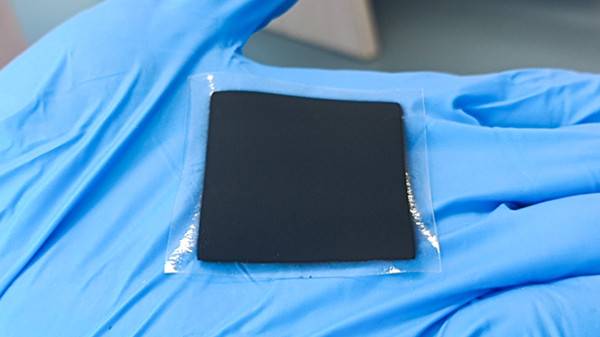
In the performance optimization research of energy materials, ultrasonic sprayers can also help achieve precise control of the material’s microstructure. By controlling the size and deposition rate of atomized droplets, researchers can construct coatings with specific porous structures—structures of great significance in energy materials. For example, in fuel cell catalyst coating research, porous structures increase the contact area between the catalyst and reactant gases, improving catalytic efficiency; in supercapacitor electrode material research, a suitable pore distribution facilitates electrolyte penetration and ion transport, enhancing the device’s rate performance. With the aid of ultrasonic spraying machines, laboratories can more precisely control these microstructural parameters, deeply exploring the relationship between structure and performance, providing more direct experimental evidence for optimizing the performance of energy materials.
In short, ultrasonic spraying machines, with their precision, flexibility, and low-damage operation, provide a reliable material preparation platform for laboratory research in energy materials. They not only help researchers overcome the technical challenges of traditional equipment in sample preparation but also provide strong support for performance exploration and process optimization of energy materials through precise control of experimental conditions, promoting the more efficient transformation of laboratory research results into practical applications.
About Cheersonic
Cheersonic is the leading developer and manufacturer of ultrasonic coating systems for applying precise, thin film coatings to protect, strengthen or smooth surfaces on parts and components for the microelectronics/electronics, alternative energy, medical and industrial markets, including specialized glass applications in construction and automotive.
Our coating solutions are environmentally-friendly, efficient and highly reliable, and enable dramatic reductions in overspray, savings in raw material, water and energy usage and provide improved process repeatability, transfer efficiency, high uniformity and reduced emissions.
Email: market2@cheersonic.com

评论
发表评论