Ultrasonic Fabric Coating Technology
Ultrasonic Fabric Coating Technology
Ultrasonic Fabric Coating Technology: Precision, Functional, and Green Solutions
Fabric surface coating is a core processing technology in functional textiles, industrial filtration, medical protective equipment, aerospace, and other fields. Its core objective is to impart customized properties such as waterproofing, stain resistance, antibacterial properties, high-temperature resistance, breathability, and conductivity to fabric substrates by depositing specific functional coatings on the surface. Traditional coating technologies (such as dip coating, blade coating, and roller coating) generally suffer from poor coating uniformity, significant material waste, substantial fabric damage, and significant environmental impact, making it difficult to meet the stringent requirements of high-end fields for coating precision, functionality, and production efficiency.
Based on years of accumulated core ultrasonic technology, we have launched a series of ultrasonic fabric coating equipment. Utilizing a unique ultrasonic atomization principle, we achieve precise control and performance upgrades in fabric surface coating, providing a comprehensive solution for both laboratory research and industrial production.
Principles and Core Advantages of Ultrasonic Fabric Coating Technology
1. Technical Principles
Ultrasonic fabric coating technology uses high-frequency ultrasonic vibration (adjustable from 20kHz to 100kHz) to form micron-sized uniform droplets from the coating material (water-based, oil-based, solvent-based, or functional slurry). These droplets are then uniformly deposited onto the fabric surface via precise airflow guidance. The entire process requires no high-pressure airflow impact, and the droplet size can be precisely controlled within the range of 5μm-50μm. Combined with a synchronously operating fabric conveying system and online monitoring module, dynamic optimization of coating thickness and coverage density is achieved, fundamentally solving problems such as uneven atomization and excessive coating penetration in traditional technologies.

2. Core Technological Advantages
Superior Coating Uniformity and Precision:
The droplet size distribution generated by ultrasonic atomization is narrow and highly consistent, enabling ultra-thin coatings or multi-layer composite coatings within the range of 0.1μm-100μm. The coating thickness error is controlled within ±5%, effectively avoiding problems such as “edge accumulation” and “pinhole defects” in traditional coatings. This technology is particularly suitable for scenarios with extremely high functional requirements, such as medical antibacterial fabrics and aerospace high-temperature resistant fabrics. According to industry standards, the coating uniformity must meet the requirement that the area ratio of the missing coverage area is ≤2%, which this technology can easily achieve and exceed.
Minimal Fabric Damage, Preserving the Original Properties of the Substrate:
Using a low-pressure atomization mode, the droplets are deposited on the fabric surface in a gentle manner, avoiding the stretching and breakage damage to fabric fibers caused by traditional high-pressure spraying. It can perfectly adapt to various fabric substrates such as knitted, woven, and non-woven fabrics, while preserving the original core characteristics of the fabric, such as breathability and flexibility, solving the industry pain point of “functionality and comfort cannot be achieved simultaneously.” The tensile strength, tear strength, and other mechanical properties of the coated fabric retain ≥95%, meeting the requirements for substrate integrity in the HG/T 3050.2-2020 standard.
Material utilization rate increased by more than 30%
Ultrasonic atomization has strong directionality, with a droplet utilization rate of over 90%. Compared with traditional dip coating (material utilization rate of only 40%-60%), it significantly reduces coating material waste, making it particularly suitable for coating high-priced materials such as precious metal slurries and high-performance resins, significantly reducing production costs. Some equipment can achieve a coating conversion rate >95%, which is more than 4 times that of traditional two-fluid spraying.
Environmentally friendly and energy-saving, in line with the trend of green production
No high-temperature curing pretreatment is required, and energy consumption is only 1/3 of that of traditional spraying equipment; the atomization process has no severe turbulence, and the VOC emission concentration is far lower than the national environmental protection standard. It can be adapted to water-based environmentally friendly coating materials (such as fatty acid methyl ester ethoxylate sulfonate compound system), helping enterprises achieve “low-carbon production” and avoid environmental policy risks. This technology reduces the release of materials into the atmosphere, lowers or eliminates the need for wastewater treatment, and offers significant environmental advantages.
Multifunctional Adaptability and Flexible Customization
It supports precise coating of single-function coatings (such as waterproof, antibacterial) and multi-layer composite coatings (such as “waterproof + breathable + conductive”). The number of atomizing heads, delivery system parameters, and online monitoring solutions can be customized according to fabric width (laboratory type supports 5cm-50cm, industrial type supports 1m-3m), operating speed (0.5m/min-20m/min), coating thickness, and other requirements, adapting to all scenarios from small-batch laboratory R&D to large-scale industrial production. The equipment can be equipped with multiple models of ultrasonic nozzles to achieve precise preparation of coatings from tens of nanometers to tens of micrometers.
Core Application Scenarios and Industry Solutions
1. Functional Textile Field
- Pain Points: Traditional waterproof coatings easily lead to poor fabric breathability, stiff hand feel, insufficient washability of anti-fouling coatings, and difficulty in controlling coating consistency during mass production, with test results from different companies deviating by more than 10%.
- Solution: Ultrasonic coating enables ultra-thin, uniform coating of environmentally friendly waterproof and stain-resistant materials such as polysiloxanes and fluorocarbons, with coating thickness as low as 1μm-5μm. This ensures both waterproof and stain-resistant performance (waterproof rating up to IPX7, stain resistance up to AATCC 130-2020 standard) and maintains fabric breathability (breathability ≥5000g/(m²·24h)). For antibacterial fabrics, it can precisely deposit antibacterial slurries such as silver and zinc ions, achieving an antibacterial rate ≥99% and a washability of over 50 cycles, meeting the accelerated washing requirements of AATCC 61-2A standard. Suitable for outdoor clothing, home textiles, and special workwear, it addresses the ecological risks associated with traditional fluorinated coatings.
2. Medical Protective Equipment
- Pain Points: Medical protective fabrics (such as surgical gowns and mask outer layers) must simultaneously meet antibacterial, waterproof, breathable, and droplet-proof requirements. Traditional coating technologies struggle to balance multiple performance indicators and pose material residue risks, making biocompatibility difficult to guarantee.
- Solution: Ultrasonic coating equipment is compatible with biocompatible coating materials (such as chitosan and polylactic acid) to achieve precise deposition of ultra-thin antibacterial coatings. This prevents the penetration of bodily fluids and droplets while ensuring breathability and preventing stuffiness. The equipment uses food-grade contact materials, ensuring no secondary pollution during the coating process and meeting the requirements of the ISO 13485 medical device quality management system. The coating’s cytotoxicity testing requires a human dermal fibroblast activity of ≥80%. The coating prepared using this technology achieves a cell activity of 87.94%, fully meeting medical-grade standards and assisting medical protective equipment companies in producing high-grade protective fabrics.
3. Aerospace and New Energy Fields
- Pain Points: Aerospace fabrics (such as cabin interior fabrics and high-temperature filtration fabrics) need to possess high-temperature resistance (-50℃-200℃), corrosion resistance, and low VOC release characteristics. Flexible photovoltaic backsheet fabrics and battery separator fabrics in the new energy field need to possess insulation, aging resistance, and high breathability. Traditional coating technologies struggle to meet performance stability requirements under extreme environments.
- Solution: Ultrasonic coating can precisely coat special materials such as high-temperature resistant resins (e.g., polyimide) and ceramic matrix composites. The coating has strong adhesion to the fabric substrate (peel strength ≥ 5N/25mm), meeting the requirements of ASTM D903 standards, and maintaining stable performance under extreme temperature and chemical environments. For flexible photovoltaic backsheet fabrics, ultra-thin insulating coatings can be applied, with insulation resistance ≥ 10¹²Ω, while ensuring high light transmittance and breathable heat dissipation, contributing to the lightweight and flexible development of new energy products. The coating shows no interface peeling after 50 thermal cycles from -10℃ to 150℃, meeting the requirements for use in extreme environments.
4. Industrial Filtration and Environmental Protection Fields
- Pain Points: Industrial filter fabrics (such as high-temperature flue gas filters and liquid filter fabrics) need to possess high-precision filtration, wear resistance, and easy-to-clean properties. Traditional coated filter layers are prone to peeling and clogging, leading to decreased filtration efficiency and short service life.
- Solution: Ultrasonic coating equipment can coat the surface of filter fabrics with functional materials such as PTFE (polytetrafluoroethylene) and ceramic coatings to form a uniform microporous filtration structure. The filtration accuracy can reach 0.1μm-1μm, while improving the wear resistance and anti-clogging performance of the fabric and extending its service life by 2-3 times. This coating maintains its structural integrity after 1000 Martindale abrasion cycles, achieving a separation efficiency of ≥98.5% for rapeseed oil/water mixtures. After 20 cycles, the efficiency is still >95%, making it suitable for industrial filtration scenarios in industries such as power, chemical, and water treatment.
Ultrasonic Fabric Coating Equipment Series and Customized Services
Core Equipment Series
Laboratory-type Ultrasonic Fabric Coating Machine
- Applicable Scenarios: Small-batch R&D, formula optimization, parameter verification (such as research on the correlation between coating thickness, droplet size, and fabric performance).
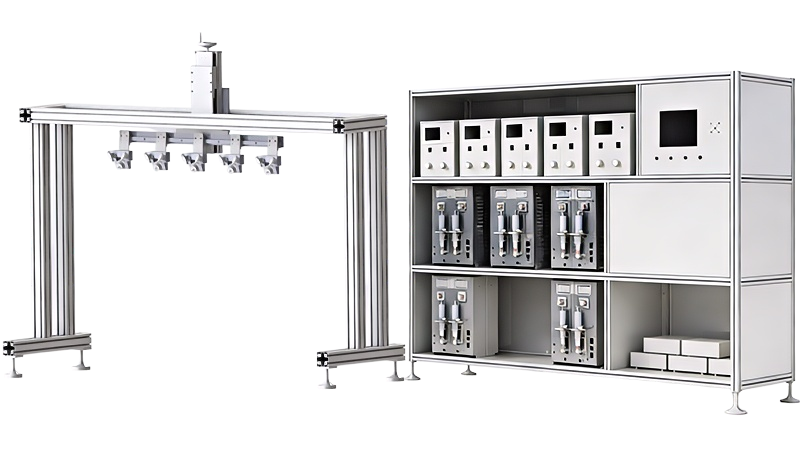
- Core Configuration: Adjustable ultrasonic atomizing heads (1-2 units), miniature precision delivery system (flow rate accuracy ±0.01mL/min), small fabric conveying platform (width 5cm-50cm, speed 0.1m/min-5m/min), online thickness monitoring module (accuracy ±0.01μm). Some equipment is equipped with an XYZ three-axis high-precision servo motion system and laser-assisted positioning function, facilitating quick setting of the spraying start position.
- Core Advantages: Compact size (≤1m²), easy operation, precisely adjustable parameters, supports multi-material compatibility testing, equipped with a full-color touchscreen control and a user-friendly human-machine interface, helping research institutions and enterprise R&D departments to quickly advance functional fabric formulation and process optimization.
Industrialized Ultrasonic Fabric Coating Production Line
- Applicable Scenarios: Large-scale continuous production (such as batch processing of functional fabrics, medical protective fabrics, and industrial filter fabrics).
- Core Configuration: Multiple ultrasonic atomizing heads (4-16 units available upon request, supporting full coverage of wide-width fabrics), high-precision metering and delivery system (flow rate range 1mL/min-100mL/min), high-speed fabric conveyor line (width 1m-3m, speed 0.5m/min-20m/min), intelligent temperature control module (temperature accuracy ±1℃), online visual inspection system (real-time monitoring of coating uniformity, automatic feedback adjustment). Some production lines can be expanded with vacuum adsorption heating plates, suitable for easily deformable or flexible substrates.
- Core Advantages: High production capacity (daily capacity up to 1000㎡-5000㎡), strong stability (continuous operation ≥24 hours without failure), high degree of automation (supports PLC programming and MES system integration), enabling full digital control of the coating process, reducing manual intervention, improving product qualification rate, and meeting the batch production quality consistency requirements of HG/T 3050.2-2020 standard.
2. Customized Services
Based on the core advantages of ultrasonic technology, we can provide end-to-end customized solutions for clients in various industries:
- Process Customization: Optimize atomization parameters, material delivery schemes, and curing processes according to the characteristics of the fabric substrate (fiber type, porosity, thickness) and coating functional requirements (waterproof, antibacterial, high-temperature resistance, etc.);
- Equipment Customization: Customize equipment dimensions, atomization head layout, and delivery system speed range for special fabric widths, production site limitations, and capacity requirements. We can also expand with accessories such as high-temperature heating platforms (up to 800℃) and exhaust gas purification devices;
- Technical Support: Provide laboratory pilot-scale and intermediate-scale verification services, assist clients in migrating process parameters and debugging production lines, and provide long-term operation and maintenance support and upgrade services with a professional technical team. We also guide companies in building quality control systems according to relevant standards.
Value of Technology Empowerment: Cost Reduction and Efficiency Improvement Throughout the R&D-Production Cycle
For laboratory researchers, ultrasonic coating equipment enables precise control of coating parameters and high repeatability of experimental data, shortening the functional fabric R&D cycle by more than 30% and providing reliable process support for technology transfer. For enterprise production line engineers, the equipment can reduce unit product production costs by 15%-25% by improving material utilization, reducing energy consumption, and decreasing defect rates, while meeting environmental policy requirements and the functional demands of the high-end market, helping enterprises build core competitiveness. After implementing this technology, enterprises have improved the repeatability of testing data, reduced the defect rate by 3%-5%, reduced raw material waste, and significantly improved their success rate in bidding.
As a professional service provider in the field of ultrasonic technology, we consistently focus on the industry pain points of fabric surface coating, with “precise atomization, customized adaptation, and green efficiency” as our core. Through technological innovation and full-process services, we promote the technological upgrading of the functional fabric processing industry. Whether it’s small-batch verification in the laboratory R&D stage or large-scale application in industrial production, we can provide highly adaptable and cost-effective ultrasonic coating solutions, exploring the infinite possibilities of fabric functionalization with our clients.
About Cheersonic
Cheersonic is the leading developer and manufacturer of ultrasonic coating systems for applying precise, thin film coatings to protect, strengthen or smooth surfaces on parts and components for the microelectronics/electronics, alternative energy, medical and industrial markets, including specialized glass applications in construction and automotive.
Our coating solutions are environmentally-friendly, efficient and highly reliable, and enable dramatic reductions in overspray, savings in raw material, water and energy usage and provide improved process repeatability, transfer efficiency, high uniformity and reduced emissions.
Email: market2@cheersonic.com

评论
发表评论