Ultrasonic Atomization Spraying for High-Quality Thermoelectric Composite Films Based on SWCNT/Tungsten Disulfide Nanosheet Dispersions
Ultrasonic Spray Deposition Strategy for Stable Single-Walled Carbon Nanotube/Tungsten Disulfide Thermoelectric Composite Layers
This thermoelectric-specific single-walled carbon nanotube thin-layer tungsten disulfide dispersion is a high-end composite nano-dispersion system specifically developed for the thermoelectric conversion field. It uses thin-layer tungsten disulfide nanosheets as the core and single-walled carbon nanotubes as the conductive reinforcing phase, prepared through a precise composite dispersion process. It combines the synergistic advantages of two-dimensional transition metal sulfides and carbon nanomaterials, making it a core supporting material for high-end thermoelectric devices such as flexible thermoelectric fabrics and high-efficiency thermoelectric sensors. Its appearance is a uniform black dispersion liquid with excellent stability, allowing for long-term storage without aggregation. It contains 1-10 thin-layer tungsten disulfide sheets with a lateral dimension of 50nm-1μm, and single-walled carbon nanotubes with a diameter of 1-2nm. The dispersion concentration can be customized. It is prepared using a liquid-phase ultrasonic exfoliation combined with conductive polymer-assisted dispersion technology, and is compatible with various solvent systems such as water-ethanol and NMP. Compared to ordinary tungsten disulfide dispersions, its thermoelectric properties, dispersion stability, and interfacial adhesion are significantly improved, precisely matching the precision coating requirements of thermoelectric devices.
Although the performance of this dispersion is suitable for thermoelectric applications, the high surface energy of its thin-layer tungsten disulfide sheets, the high aspect ratio of its single-walled carbon nanotubes, and the dispersion sensitivity of the composite system limit the achievement of high-quality film formation using traditional spraying processes. Thin-layer tungsten disulfide sheets are prone to stacking and agglomeration due to van der Waals forces, while single-walled carbon nanotubes are prone to entanglement. When these two are combined, the agglomeration phenomenon is even more pronounced, disrupting thermoelectric transport channels and leading to a significant decrease in thermoelectric conversion efficiency. Simultaneously, the thin-layer tungsten disulfide sheet structure is fragile; the high-pressure impact and mechanical shearing forces of traditional pneumatic spraying and spin coating processes easily cause sheet peeling and structural damage. Single-walled carbon nanotubes are also prone to breakage, and the dispersion is prone to delamination, resulting in uneven coating thickness and poor density. This fails to meet the stringent requirements of thermoelectric devices for coating uniformity and performance stability, greatly limiting its large-scale application in the thermoelectric field.
Cheersonic ultrasonic spraying machines, specifically designed for the composite characteristics of thermoelectric single-walled carbon nanotube thin-layer tungsten disulfide dispersions, offer a customized precision spraying process, completely resolving the various pain points of traditional processes. The equipment employs a 20-120kHz high-frequency ultrasonic atomization principle, converting electrical energy into high-frequency mechanical vibration through a piezoelectric transducer. This uniformly atomizes the dispersion into micron-sized fine droplets. The entire process involves low-pressure, gentle atomization, eliminating high-pressure impacts and mechanical shearing, achieving a “soft landing” of the droplets. This maximizes the protection of the integrity of the thin-layer tungsten disulfide sheets and the single-walled carbon nanotube structure, preventing sheet damage and tube breakage. Simultaneously, it effectively inhibits the aggregation of both materials, preventing dispersion stratification and precisely preserving their synergistic thermoelectric advantages. High-frequency atomization ensures uniform distribution of the two materials within the droplets, fundamentally addressing defects such as coating porosity and uneven thickness, and constructing a continuous and efficient thermoelectric transfer channel.
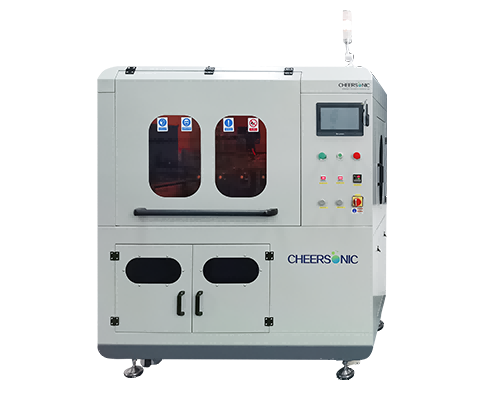
Compared to traditional spraying processes, Cheersonic ultrasonic spraying equipment offers significant advantages. The equipment boasts high atomization uniformity, with coating thickness uniformity consistently within a 5% deviation. It enables the fabrication of nanoscale ultrathin continuous films, producing dense coatings free of pinholes and cracks, effectively improving thermoelectric conversion efficiency and meeting the stringent performance requirements of thermoelectric devices. The non-contact directional deposition spraying method allows for dispersion utilization exceeding 90%, a significant improvement over traditional processes, greatly reducing production costs and aligning with green production principles. The equipment is highly compatible, adaptable to dispersions of varying concentrations and solvent systems, and suitable for diverse thermoelectric device substrates such as flexible fabrics, silicon wafers, and metals. It enables both large-area uniform spraying and small-area precision spraying, meeting the needs of both laboratory R&D and industrial mass production. The self-cleaning nozzle design prevents clogging and reduces maintenance downtime.
In practical applications, thermoelectric films prepared by the Cheersonic ultrasonic spraying machine exhibit stable performance and good repeatability, making them widely applicable in the thermoelectric field. In the field of flexible thermoelectric fabrics, self-powered smart body temperature monitoring fabrics can be prepared, generating stable electrical signals even under small temperature differences, making them suitable for wearable electronics. In the field of thermoelectric sensors, they can be used for high-precision temperature detection and fire early warning, offering rapid response and excellent sensitivity. In the field of new energy thermoelectric devices, they can improve the power factor of devices, achieving efficient conversion of thermal and electrical energy, suitable for smart buildings, new energy power generation, and other scenarios. They can also be used in the preparation of flexible semiconductor-type composite thermoelectric materials, contributing to the upgrading of thermoelectric technology.
Today, thermoelectric technology is increasingly widely used in wearable electronics, new energy, and smart monitoring, leading to continuously increasing demands for the spraying precision and stability of thermoelectric-specific single-walled carbon nanotube thin-layer tungsten disulfide dispersions. Cheersonic Ultrasonic Equipment Co., Ltd., with years of experience in nano-spraying, has optimized spraying processes based on the characteristics of thermoelectric materials. Relying on mature equipment technology and a complete process system, it provides efficient, stable, and cost-effective complete solutions for the precise film formation of this dispersion, helping various thermoelectric device companies achieve technological upgrades and mass production.
About Cheersonic
Cheersonic is the leading developer and manufacturer of ultrasonic coating systems for applying precise, thin film coatings to protect, strengthen or smooth surfaces on parts and components for the microelectronics/electronics, alternative energy, medical and industrial markets, including specialized glass applications in construction and automotive.
Our coating solutions are environmentally-friendly, efficient and highly reliable, and enable dramatic reductions in overspray, savings in raw material, water and energy usage and provide improved process repeatability, transfer efficiency, high uniformity and reduced emissions.

评论
发表评论